

Understanding Envelope Sizes in the UK: A Complete Guide

Choosing the correct envelope size is an important part of professional mailing. Whether you’re sending invoices, contracts, brochures, certificates, or personal correspondence, using the right envelope helps protect your documents, reduces postage costs, and creates a professional impression.
However, many people are unfamiliar with the various envelope sizes available in the UK and when each one should be used.
This guide explains the most common envelope sizes, their dimensions, and the best applications for each format.
Why Envelope Size Matters
Using the correct envelope offers several advantages:
- Better document protection
- Professional presentation
- Reduced postage costs
- Improved mailing efficiency
- Easier document organisation
Choosing an envelope that is too small may require unnecessary folding, while an oversized envelope can increase mailing costs and allow contents to move during transit.
Understanding the UK Envelope Size System
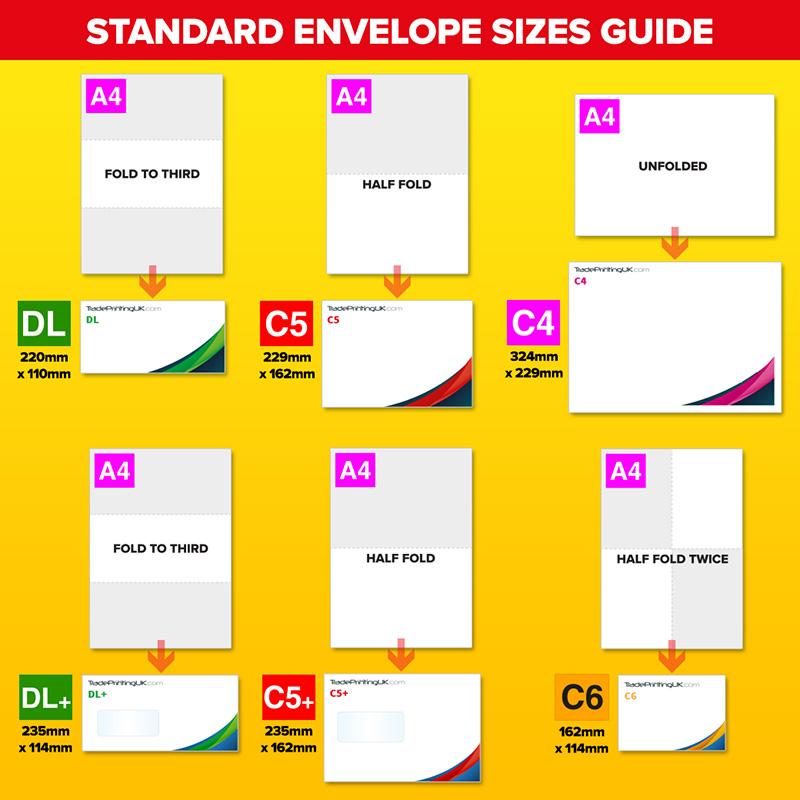
Most envelopes used in the UK follow the ISO 216 paper size standard, which is based on A-series paper sizes.
Envelope sizes are typically identified using the C-series format.
For example:
- C4 envelopes are designed for A4 documents.
- C5 envelopes are designed for A5 documents or folded A4 sheets.
- C6 envelopes are designed for A6 documents or folded A4 sheets.
The “C” size is specifically created to accommodate corresponding paper sizes.
C4 Envelopes
Dimensions
324mm x 229mm
Suitable For
- A4 documents without folding
- Contracts
- Certificates
- Reports
- Legal documents
- Business presentations
C4 envelopes are widely used when documents need to remain flat and professional-looking throughout delivery.
Advantages
- No folding required
- Professional presentation
- Excellent document protection
C5 Envelopes
Dimensions
229mm x 162mm
Suitable For
- A4 documents folded once
- Brochures
- Business letters
- Marketing materials
- Statements
C5 envelopes are one of the most popular choices for everyday business correspondence.
Advantages
- Cost-effective
- Compact size
- Professional appearance
DL Envelopes
Dimensions
220mm x 110mm
Suitable For
- A4 documents folded into thirds
- Invoices
- Statements
- Quotations
- General business correspondence
DL envelopes are among the most commonly used envelopes in offices across the UK.
Advantages
- Ideal for standard letters
- Lower postage costs
- Widely compatible with window envelope formats
C6 Envelopes
Dimensions
162mm x 114mm
Suitable For
- Greetings cards
- Invitations
- A6 documents
- Small promotional materials
C6 envelopes are commonly used for personal correspondence and event invitations.
Advantages
- Compact and practical
- Popular for card mailing
- Cost-effective for small items
C3 Envelopes
Dimensions
458mm x 324mm
Suitable For
- Large documents
- Posters
- Architectural drawings
- Artwork
- Marketing displays
C3 envelopes are designed for oversized documents that should remain completely flat.
Advantages
- Maximum protection
- No folding required
- Ideal for professional presentations
Envelope Size Comparison Table
| Envelope Size | Dimensions | Holds |
|---|---|---|
| C3 | 458mm x 324mm | A3 documents flat |
| C4 | 324mm x 229mm | A4 documents flat |
| C5 | 229mm x 162mm | A4 folded once |
| C6 | 162mm x 114mm | A4 folded twice |
| DL | 220mm x 110mm | A4 folded into thirds |
This simple guide helps ensure you choose the most suitable envelope for your mailing requirements.
Which Envelope Size Is Best for Business Use?
The answer depends on the type of documents you regularly send.
For Invoices and Statements
DL Window Envelopes are usually the preferred choice.
For Contracts and Certificates
C4 Envelopes provide the best presentation and protection.
For Marketing Brochures
C5 Envelopes offer a balance between appearance and mailing costs.
For Invitations and Greeting Cards
C6 Envelopes are often the ideal solution.
How to Reduce Mailing Costs
Selecting the correct envelope size can help reduce postage expenses.
Consider the following:
- Use the smallest suitable envelope.
- Avoid excessive empty space.
- Match envelope size to document dimensions.
- Choose lightweight materials when appropriate.
These simple steps can lead to significant savings, particularly for businesses sending large volumes of mail.
Frequently Asked Questions
What is the most commonly used envelope size in the UK?
DL envelopes are generally the most popular for business correspondence, invoices, and statements.
Which envelope fits an A4 document without folding?
A C4 envelope is specifically designed to hold an A4 document flat.
Can I send brochures in a C5 envelope?
Yes. C5 envelopes are commonly used for brochures, leaflets, and folded A4 documents.
What envelope should I use for certificates?
C4 envelopes are usually recommended because they allow certificates to remain flat and undamaged.
Conclusion
Understanding envelope sizes can help improve mailing efficiency, reduce costs, and ensure your documents arrive in excellent condition.
Whether you need a DL envelope for invoices, a C5 envelope for brochures, or a C4 envelope for important documents, selecting the correct size is a simple way to improve both presentation and practicality.
By choosing the right envelope for every mailing task, businesses and individuals can achieve more professional, secure, and cost-effective communication.
Great content! Keep up the good work!