

Royal Mail Letter and Parcel Size Guide 2026

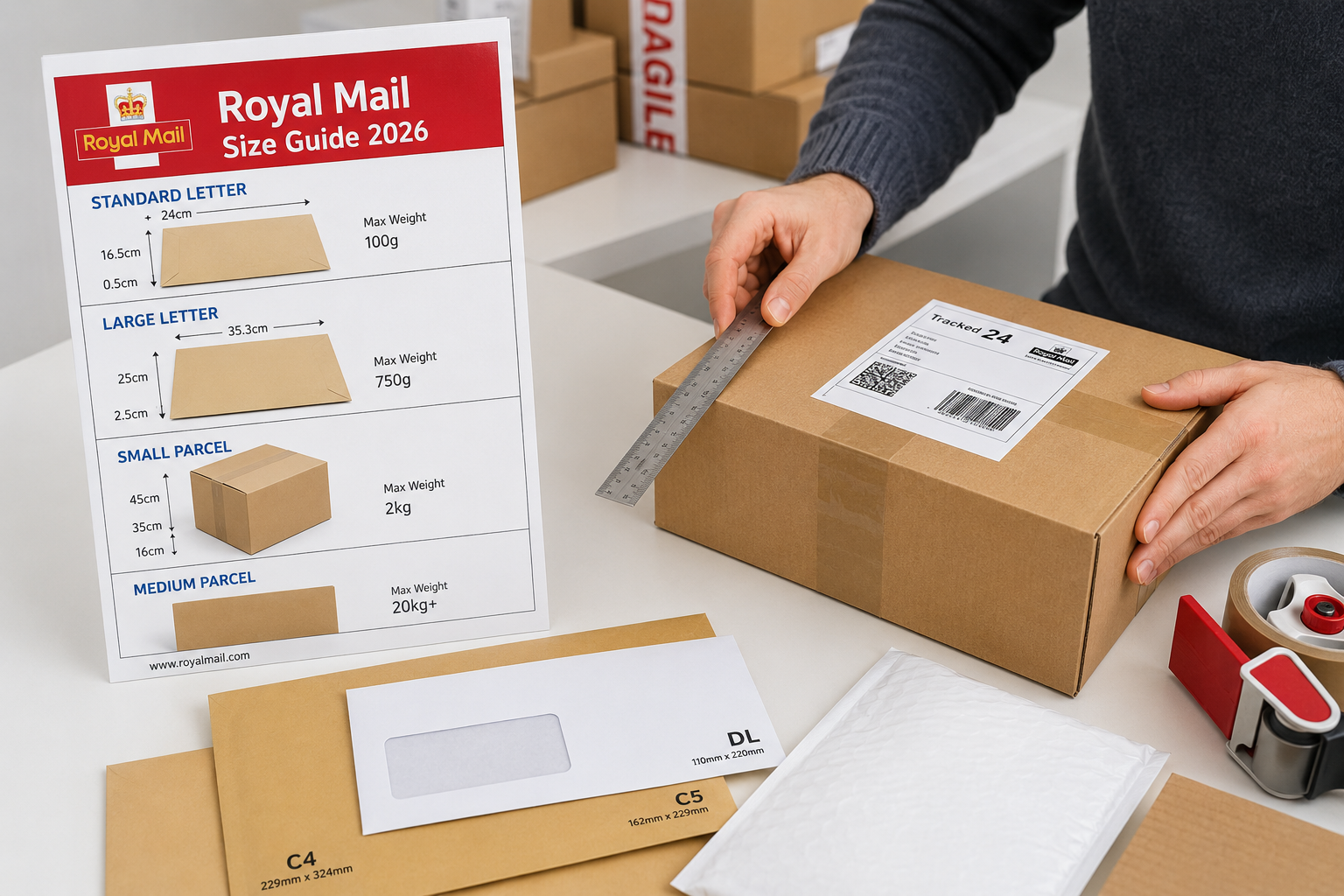
Choosing the correct Royal Mail letter or parcel size is important for both businesses and individuals. Sending an item in the wrong format can lead to higher postage costs, delivery delays, or additional surcharge fees. Whether you’re posting invoices, documents, books, clothing, or e-commerce orders, understanding Royal Mail’s size categories helps you save money and ensure smooth delivery.
In this guide, we’ll explain the most common Royal Mail letter and parcel sizes and help you choose the right packaging for your shipments.
Royal Mail Standard Letter Sizes
A Standard Letter is designed for lightweight documents, letters, invoices, and greeting cards.
Maximum Dimensions:
- Length: 24 cm
- Width: 16.5 cm
- Thickness: 0.5 cm
- Weight: 100 g
Items exceeding any of these dimensions will normally move into the Large Letter category.
Common Uses
- Business correspondence
- Invoices
- Letters
- Greeting cards
- Small documents
Royal Mail Large Letter Sizes
The Large Letter format is one of the most popular options for businesses because it allows larger documents and flat products to be sent at a lower cost than a parcel.
Maximum Dimensions:
- Length: 35.3 cm
- Width: 25 cm
- Thickness: 2.5 cm
- Weight: 750 g
This format is ideal for:
- A4 documents
- Brochures
- Magazines
- Certificates
- Catalogues
- Flat e-commerce products
Recommended Envelope Sizes
C4 Envelopes
Perfect for sending A4 documents without folding.
C5 Envelopes
Suitable for A4 documents folded once.
DL Envelopes
Ideal for letters folded into thirds.
Choosing the correct envelope size helps maintain a professional appearance while ensuring compliance with Royal Mail requirements.
Royal Mail Small Parcel Sizes
If your item exceeds the Large Letter thickness limit of 25 mm, it will usually need to be sent as a Small Parcel.
Maximum Dimensions:
- Length: 45 cm
- Width: 35 cm
- Depth: 16 cm
- Weight: 2 kg
Typical Uses
- Clothing
- Small electronics
- Books
- Boxed products
- Online retail orders
Many online businesses aim to keep products within Large Letter dimensions because postage costs are often significantly lower than Small Parcel rates.
Medium and Large Parcels
For larger shipments, Royal Mail offers Medium and Large Parcel services.
These services are commonly used for:
- Bulk orders
- Warehouse shipments
- Home moving supplies
- Large retail products
Selecting the right parcel category ensures you avoid unnecessary postage costs while providing adequate protection for your goods.
How to Measure Your Package Correctly
Before purchasing postage, always measure:
- Length (the longest side)
- Width
- Thickness or depth
- Total weight
Even a few millimetres over the permitted dimensions can move your shipment into a more expensive category.
One of the most common mistakes businesses make is exceeding the 25 mm thickness limit for Large Letters.
Best Packaging for Royal Mail Deliveries
To minimise postage costs and protect your items during transit, choose packaging that matches the size category of your shipment.
For Documents
- C4 envelopes
- C5 envelopes
- DL envelopes
- Board-backed envelopes
For Small Products
- Bubble mailers
- Padded envelopes
- Postal boxes
For Parcels
- Single-wall cardboard boxes
- Double-wall cardboard boxes
- Mailing bags
- Packaging tape
Using correctly sized packaging helps avoid wasted shipping costs and improves delivery efficiency.
Tips for E-commerce Sellers
If you operate an online store, reducing parcel dimensions can have a significant impact on shipping costs.
Consider the following:
- Use mailing bags instead of boxes where appropriate.
- Choose board-backed envelopes for flat products.
- Design packaging to fit within Large Letter dimensions whenever possible.
- Measure all products before setting shipping rates.
For many UK e-commerce businesses, qualifying for the Large Letter category can substantially reduce shipping expenses.
Conclusion
Understanding Royal Mail letter and parcel sizes is essential for avoiding unnecessary postage costs and ensuring reliable delivery.
For documents, invoices, and marketing materials, Large Letter packaging such as C4, C5, and board-backed envelopes is often the most cost-effective option. For larger or bulkier items, postal boxes and mailing bags provide the protection needed for safe transit.
By choosing the correct packaging and staying within Royal Mail size limits, businesses can improve efficiency, reduce shipping costs, and provide a better experience for their customers.