

Window vs Non-Window Envelopes: Which Should You Choose?

Choosing the right envelope may seem like a small detail, but it can have a significant impact on professionalism, efficiency, and mailing costs. One of the most common questions businesses ask is whether they should use window envelopes or non-window envelopes.
Both options serve an important purpose, and the best choice depends on the type of mail you send, your workflow, and your branding requirements.
In this guide, we’ll explain the differences between window and non-window envelopes, their advantages, and when each option is most suitable.
What Is a Window Envelope?
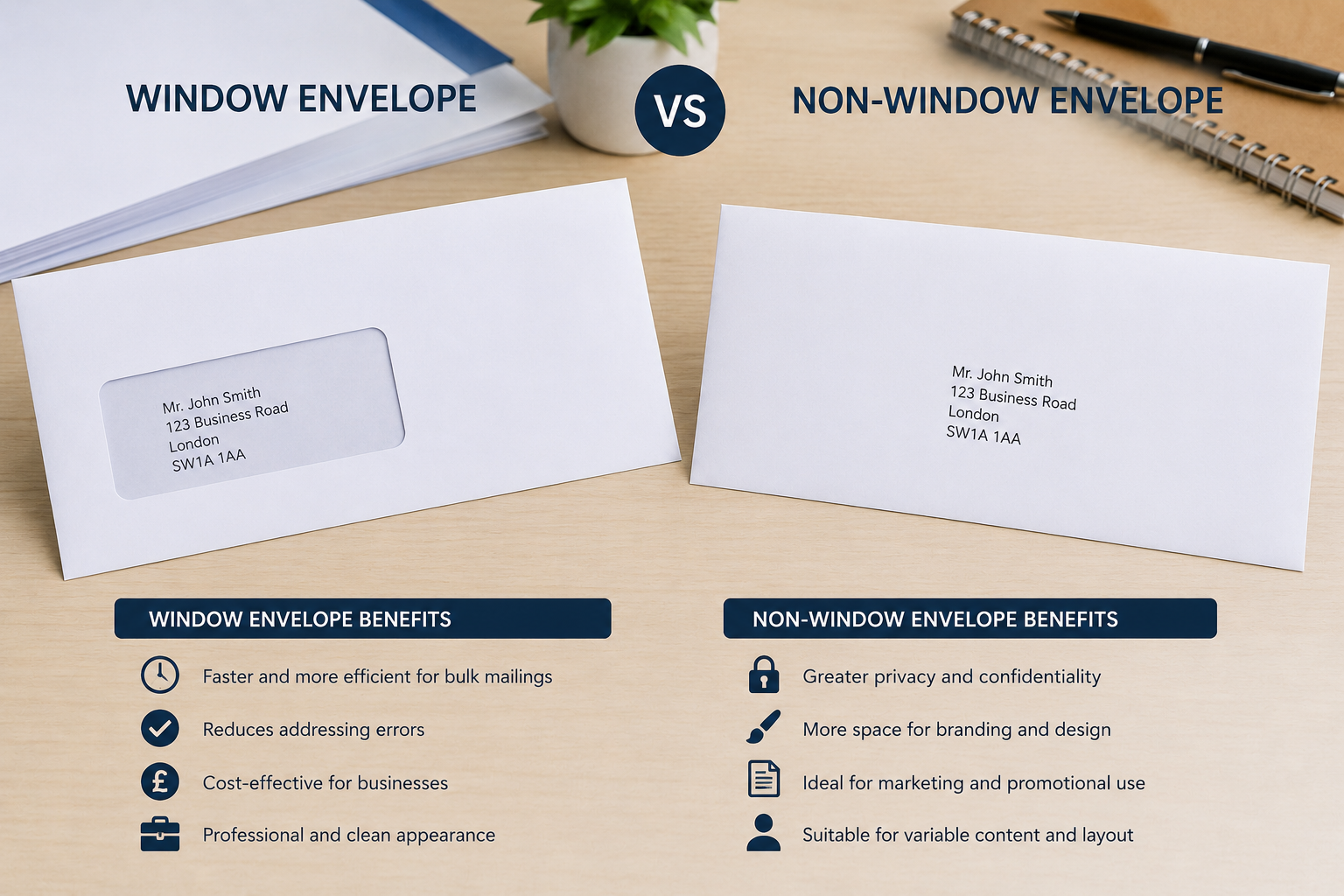
A window envelope features a transparent plastic window that allows the recipient’s address printed on the enclosed document to be visible without manually writing or printing the address on the envelope itself.
These envelopes are widely used by businesses that regularly send:
- Invoices
- Statements
- Utility bills
- Payroll documents
- Official correspondence
- Marketing letters
The address is positioned on the document so it aligns perfectly with the envelope window.
Benefits of Window Envelopes
Faster Mailing Process
One of the biggest advantages is efficiency. Since the address appears through the window, there is no need to print labels or manually address envelopes.
This can save significant time when sending large volumes of mail.
Reduced Risk of Addressing Errors
Because the recipient information comes directly from the printed document, the chances of mismatching documents and envelopes are greatly reduced.
Professional Appearance
Window envelopes create a clean and organised appearance, particularly for invoices, statements, and business correspondence.
Cost Savings for Bulk Mailings
Businesses that send hundreds or thousands of letters each month often benefit from lower administration costs by using window envelopes.
What Is a Non-Window Envelope?
A non-window envelope is a traditional envelope without any transparent section.
The recipient’s address is either:
- Printed directly onto the envelope
- Applied using a label
- Handwritten
Non-window envelopes are commonly used for both personal and business purposes.
Common Uses
- Greeting cards
- Invitations
- Legal documents
- Certificates
- Marketing materials
- General correspondence
Non-window envelopes offer greater flexibility because the position of the enclosed document is not restricted by a window.
Benefits of Non-Window Envelopes
Greater Privacy
Since no part of the document is visible, non-window envelopes provide additional confidentiality.
This makes them ideal for:
- Legal documents
- Contracts
- Confidential business information
- Personal correspondence
More Professional Branding Options
Many businesses prefer non-window envelopes because they offer a cleaner surface for:
- Company logos
- Brand colours
- Promotional messages
- Custom printing
More Flexible Document Placement
Documents do not need to be precisely aligned to match a window opening.
This simplifies document preparation for irregular-sized inserts.
Window vs Non-Window Envelopes Comparison
| Feature | Window Envelope | Non-Window Envelope |
|---|---|---|
| Mailing Speed | Excellent | Good |
| Bulk Mailing Efficiency | Excellent | Moderate |
| Privacy | Good | Excellent |
| Branding Options | Moderate | Excellent |
| Address Printing Required | No | Yes |
| Risk of Address Errors | Lower | Higher |
| Marketing Flexibility | Moderate | Excellent |
Which Envelope Is Best for Invoices?
For invoices and account statements, window envelopes are usually the preferred choice.
They allow the recipient address printed on the invoice to show through the envelope window, eliminating the need for separate labels or envelope printing.
This is why many accounting departments and utility companies use window envelopes as their standard mailing solution.
Which Envelope Is Best for Marketing Materials?
For direct mail campaigns and promotional materials, non-window envelopes are often the better option.
A plain envelope with custom branding can:
- Increase brand recognition
- Create a more premium appearance
- Improve marketing consistency
- Support personalised campaigns
Many businesses print logos, promotional offers, or campaign messages directly onto non-window envelopes.
Which Envelope Is Best for Legal Documents?
When confidentiality is important, non-window envelopes are generally recommended.
Legal firms, financial institutions, and government organisations often prefer non-window envelopes because they provide maximum privacy and security.
Popular Envelope Sizes
DL Envelopes
Ideal for letters folded into thirds.
Commonly used for invoices, statements, and business correspondence.
C5 Envelopes
Suitable for A4 documents folded once.
Popular for business letters and marketing materials.
C4 Envelopes
Perfect for sending A4 documents without folding.
Often used for contracts, reports, and important documents.
How Businesses Choose Between Window and Non-Window Envelopes
The choice usually depends on mailing volume and document type.
Businesses sending large quantities of invoices often choose window envelopes because they streamline the mailing process and reduce administrative work.
Companies focused on branding, marketing, or confidential communications frequently prefer non-window envelopes due to their flexibility and professional appearance.
Many organisations use both types depending on the purpose of the mailing.
Conclusion
Both window and non-window envelopes have clear advantages.
Window envelopes are ideal for high-volume business mailings such as invoices and statements, helping improve efficiency and reduce addressing errors.
Non-window envelopes provide greater privacy, branding opportunities, and flexibility, making them suitable for legal documents, marketing campaigns, and general correspondence.
By selecting the right envelope for each mailing purpose, businesses can improve efficiency, maintain a professional image, and ensure their communications reach recipients in the best possible way.